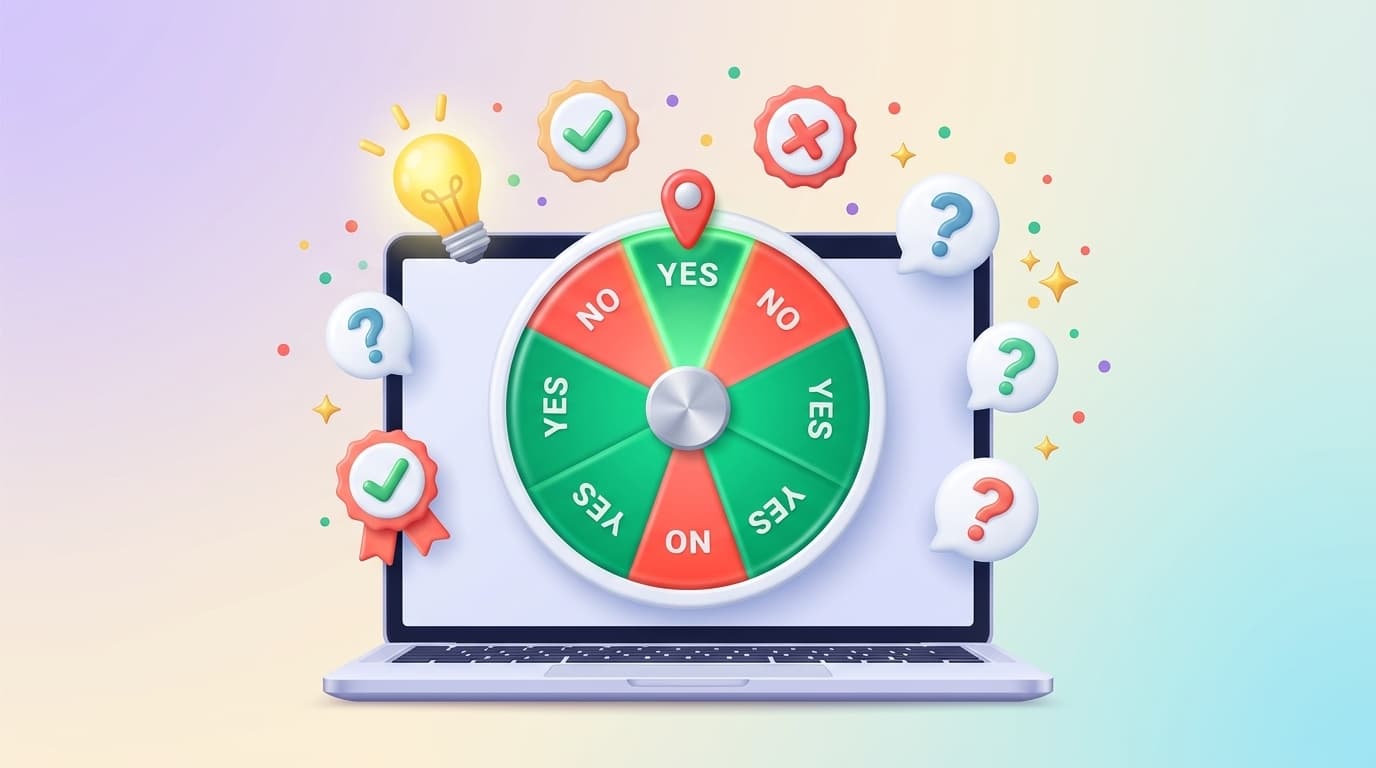
Introduction: The Hidden Trap of Everyday Decisions
You sit down to work at 9:00 AM, but before opening your task manager, you spend ten minutes debating whether to reply to an email or start an outline. At noon, you and your colleagues spend fifteen minutes debating two lunch spots. By evening, you scroll through streaming titles for another twenty minutes before giving up entirely.
None of these choices are critical. Yet each one levies an invisible tax: Analysis Paralysis.
Modern adults face roughly 35,000 decisions each day. While we like to believe our rational minds weigh every option logically, the reality is exhausting. When faced with equally balanced, low-stakes choices, our brains stall. We over-analyze minor options, drain our willpower, and leave ourselves depleted when complex problems demand attention.
The solution is not more deliberation—it is better decision architecture.
When you reduce an overthought dilemma to a crisp binary choice and outsource the tie-breaker to an unbiased tool—like a spin the wheel yes or no spinner—you do not surrender control. Instead, you activate a psychological shortcut that clears cognitive clutter and instantly clarifies your true preference.
Here is the cognitive science of why we freeze, how external randomness restores momentum, and how to use a Yes or No decision wheel to reclaim hours of wasted mental energy each week.
The Cognitive Cost of Everyday Choices: Why Your Brain Gets Stuck
To eliminate overthinking, we must examine why the brain treats minor dilemmas with excessive gravity.
1. Decision Fatigue and Ego Depletion
Cognitive psychology confirms that every decision you make—from choosing an outfit to resolving a workflow conflict—draws from the exact same reservoir of mental energy.When you spend cognitive bandwidth weighing minor pros and cons, you experience ego depletion. As energy wanes, your brain seeks shortcuts—frequently defaulting to avoidance: postponing action, second-guessing, or running repetitive loops on the same two options.
2. The Illusion of the "Perfect" Choice
Analysis paralysis rarely strikes when one alternative is clearly superior. It strikes when two options are roughly equal in value or uncertainty.Should you go for a run tonight or rest? Should you prepare dinner or order takeout? Because neither choice leads to disaster, your prefrontal cortex keeps searching for a decisive third answer that does not exist. More deliberation only produces diminishing returns.
3. Reversible vs. Irreversible Decisions (Type 1 vs. Type 2)
Jeff Bezos famously divided decisions into two categories to accelerate organizational speed:- Type 1 (One-Way Doors): High-stakes, irreversible decisions (e.g., selling a company, quitting a career without savings). These warrant deep research and caution.
- Type 2 (Two-Way Doors): Reversible decisions (e.g., testing a webpage headline, picking a restaurant, choosing meeting speaking order). If the result is imperfect, you simply walk back through the door.
Over 95% of daily dilemmas are Type 2. Spending more than two minutes deliberating a reversible choice is almost always a losing trade.
The Coin-Toss Intuition Paradox: The Hidden Psychology of Randomness
Why does introducing artificial randomness help break a mental deadlock?
For decades, behavioral scientists have studied the paradox of using coin flips or spinners to settle dilemmas. The most famous observation comes from psychoanalyst Sigmund Freud: randomness does not make the decision for you; it reveals the decision your subconscious has already reached.
What Freud Observed About Chance
When patients struggled with deep ambivalence, Freud occasionally suggested assigning the competing choices to the sides of a coin and tossing it in the air.He noted that the breakthrough never occurred when the coin hit the table. It happened while the coin was still airborne.
In that fleeting second of flight, analytical defenses dropped. The patient's subconscious immediately produced a visceral reaction: acute apprehension ("I hope it is not heads") or subtle relief ("Please let it be tails"). The coin served not as an oracle, but as an emotional mirror.
The "Visceral Reaction" on a Spinning Wheel
A digital **[Yes or No wheel](/yes-or-no)** leverages this exact psychological mechanism, enhanced by visual momentum.When you enter your question and initiate a spin, alternating YES and NO segments sweep past the pointer. As the wheel decelerates and ticks toward a stop, anticipation builds. In those critical seconds, your true preference surfaces:
- If the wheel lands on YES and you feel genuine satisfaction, your answer is YES.
- If the wheel lands on YES and your immediate instinct is to say "Let's do best two out of three," your answer is actually NO.
Either way, the deadlock breaks. The wheel forces your intuitive preference to the surface without hours of debate.
High-ROI Use Cases: When to Spin (And When Not To)
A random decision tool is a productivity heuristic designed for specific contexts. Here is where a yes or no spinner delivers immediate results:
1. Crushing Task Initiation Procrastination
When a large to-do list feels overwhelming, initiation is the highest hurdle. Use the wheel for immediate micro-commitments: * *"Should I spend 15 minutes drafting this outline right now? Yes or No."* * *"Should I clear my inbox before starting research? Yes or No."* If the outcome is YES, execute immediately. If NO, shelve the task for later and move forward without guilt.2. Eliminating Workplace and Meeting Gridlock
Minutes spent arguing over trivial team logistics waste valuable payroll. Use a visual **[spin the wheel](/yes-or-no)** tool on screen to determine agenda order, select presentation sequence, or settle minor scheduling disputes. The visual format removes interpersonal friction—nobody lost to a colleague; the wheel simply landed on an answer. For dividing a team into breakout units rather than binary choices, a specialized [random team generator](/random-team-generator) offers the same impartial fairness.3. Classroom Engagement and Active Learning
Teachers often struggle with passive classrooms where the same few students volunteer while others tune out. A quick **Yes or No wheel** adds excitement to true/false reviews, reading turn assignments, and bonus point questions. Because the selection is neutral, students perceive the process as completely fair. When instructors need full student rosters or custom prize segments, they can switch effortlessly to a full-featured [wheel of names](/) for custom lists.4. Ending Relationship and Social Indecision
The perpetual question *"Where should we go tonight?"* can consume an entire evening. Frame the dilemma into an actionable binary: *"Should we try that new bistro on 4th Street? Yes or No."* If YES, put on your shoes. If NO, that option is off the table, making the backup choice obvious.Yes or No Wheel vs. Alternative Decision Methods
Choosing the right format depends on the nature of your dilemma:
| Method | Number of Outcomes | Ideal Context | Key Advantage |
|---|---|---|---|
| Yes or No Wheel | 2 (50% / 50%) | Group meetings, classrooms, personal tie-breakers | High visual clarity, engaging spin, zero bias |
| Physical Coin Toss | 2 (Heads / Tails) | Solo decisions on the go | Tactile, portable, instantaneous |
| Yes No Maybe Wheel | 3 (Yes, No, Maybe) | Nuanced dilemmas where waiting is acceptable | Built-in escape hatch for incomplete data |
| Custom Spin Wheel | Unlimited custom | Raffles, giveaways, dinner shortlists, team rosters | Supports custom labels, themes, and entry removal |
Note: While the Yes No Maybe wheel is helpful when you genuinely need permission to defer a choice, a strict 50/50 Yes or No spinner is far more effective for conquering procrastination because it eliminates the middle ground.
3 Heuristics for Mastering the Decision Wheel
To turn a decision spinner into a sustainable productivity habit, keep these three guidelines in mind:
- Ask Actionable, Near-Term Questions: Frame prompts around concrete steps you can take within 24 hours. Replace "Will my project succeed?" with "Do I publish this draft today? Yes or No."
- Respect the Subconscious Signal: If the wheel stops on NO and you immediately feel disappointment, do not re-spin. The tool has already done its job by revealing your hidden preference. Take the YES action and close the tab.
- Apply the 2-Minute Rule: If a reversible Type 2 decision takes longer than 120 seconds of deliberation, hand it to the wheel. Spend your cognitive energy executing rather than debating.
Frequently Asked Questions
Is the Yes or No Wheel mathematically 50/50?
Yes. The wheel features equal, alternating sectors of identical size. Browser-based cryptographic random number generators calculate the stopping position before the visual animation completes, ensuring each segment has an exact 50% theoretical probability on every spin.Does delegating low-stakes choices to a wheel make me indecisive?
No. Outsourcing minor, reversible choices demonstrates disciplined mental bandwidth management. Preserving willpower for high-impact decisions is a hallmark of effective thinkers.What if I need to choose among several distinct options?
If you have four restaurants or eight raffle names, a binary tool is inappropriate. Load your options into the main [spin the wheel](/) editor to create customized entries, adjust individual sector colors, and track winner history.Conclusion: Protect Your Focus for What Counts
In an era of endless options and information overload, rapid decision-making is a superpower.
Over-deliberating low-consequence dilemmas does not yield better outcomes; it simply yields cognitive fatigue. By leveraging Freud's intuition paradox and the objective simplicity of a spin the wheel yes or no tool, you can break mental deadlock, preserve valuable willpower, and maintain forward momentum throughout your day.
The next time you catch yourself frozen between two simple paths, stop overthinking. Formulate the question, give the wheel a spin, and take the next step with confidence.